superborb: (Default)


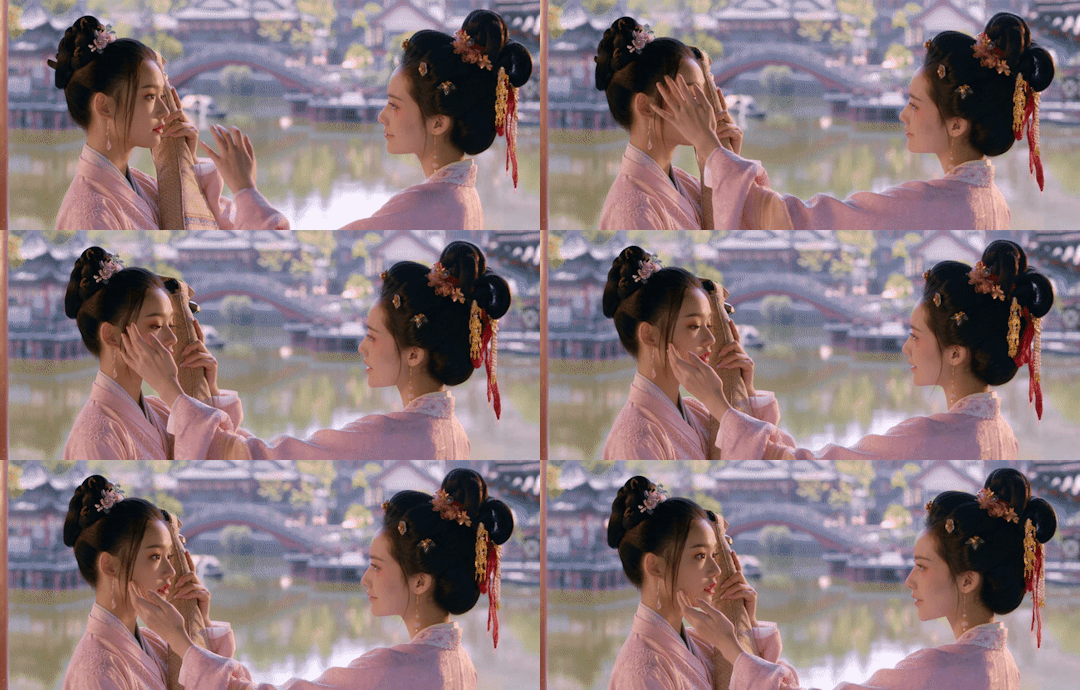
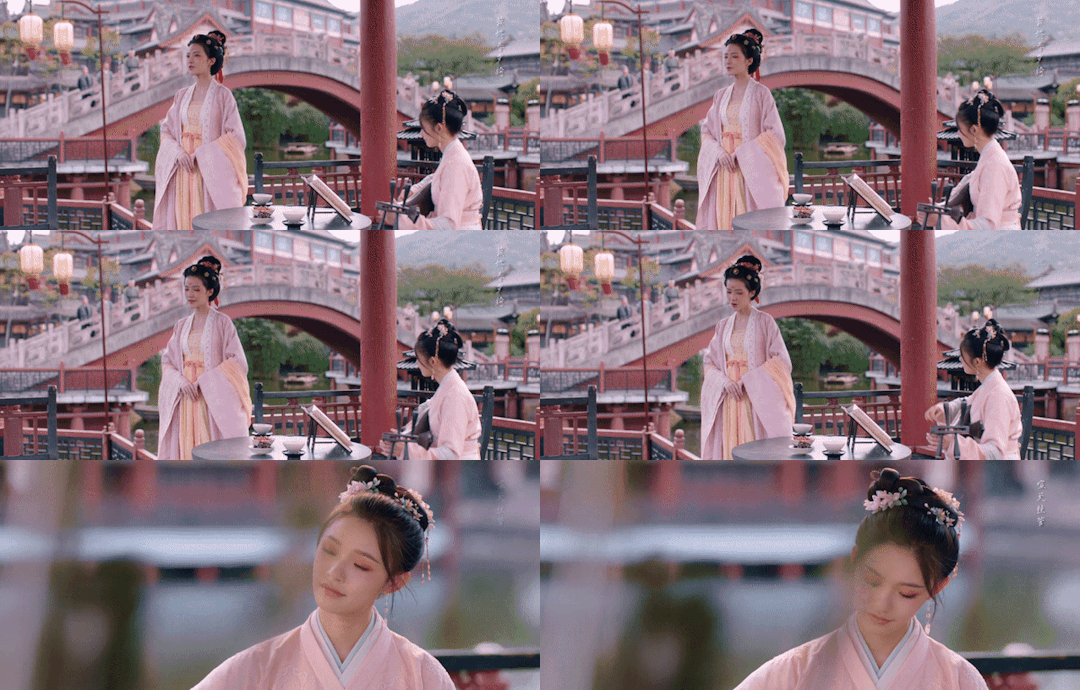
Haohao, the best singer in the capital, is incensed upon learning there is a new pipa player eclipsing her fame. Naturally, the first thing she does upon meeting said pipa player is to praise her beauty ('even I can't help falling in love upon seeing you') and play a duet with her.

Nominally based on the Yuan dynasty opera, set in the Song dynasty, this drama follows three women as they try to make a life in the capital. Zhao Panr was once a music entertainer, a legal status denoting the lowest social class, but now runs a successful small teahouse as a businesswoman. Sun Sanniang is a former butcher who dreams of her son passing the exams to become an official. Song Yinzhang is the best pipa player, which comes with the entertainer status that she desperately wants to escape.

[Spoilers ahead]
Spoiler cut! )
superborb: (Default)
I have been in Graeber purgatory for the last three months and I am STILL NOT DONE with Dawn of Everything, so uh. Some mostly non-book media! (I... am mostly enjoying it, but it's just very difficult to read through in one sitting, which makes my progress slow.)

Make, Sew and Mend, by Bernadette Banner: An overview of hand-sewing techniques. From [personal profile] sophia_sol's rec. It was well laid out in terms of the order of covered topics and mostly clear, though it was occasionally excessively wordy. There were a few times when I had to reread a sentence a dozen or so times before I understood what was happening and afterwords felt like it could have been expressed with more clarity. On the one hand, I'm not an experienced sewer so it makes sense that I would be confused sometimes; on the other, surely that is most of the intended audience, as the techniques covered are not particularly fancy. I did learn how to properly anchor my thread! And corrected a few other things that home ec misled me on.

8UPPERS: In conjunction with their album promotion, Kanjani8 released this movie, where they are gangsters who have suddenly acquired a baby. I guess a lot of background was supposed to be revealed in teasers in advance, but the plot still made sense without it. Not that the plot is that complicated or deep, but it is coherent! Mainly, they cast a cute baby and there are lots of found family scenes.

As We Like It (2021): An all-female cast retelling of As You Like It, set in a neighborhood of Taipei where internet is banned. It opens with many gay and lesbian couples as background, but an 'I'm not gay' freakout is what keeps Orlando and Rosalind-as-a-boy apart? And the het couple being able to have a baby is why they're superior? There are briefly mentioned gay couples, but it does come across as being far more comfortable with lesbians (or the playacting of a lesbian relationship) than with gay people. It tries to conclude with a 'gender doesn't matter' message at the end, but... all the main couples are het, though played by women, and the closest they get to queerness is the slight gender bending of Rosalind-as-a-boy. It was a fun romp, just not as queer as it seemed it'd be.

Luca (2021): Summer adventure coming of age movie set in Italy, where a sea monster child explores the human world for the first time. (I got the rec from someone on DW, but I can't seem to turn it up in search, as searching "Luca" also turns up hits for "Lucas"...) Fun, easy story to watch. I didn't love the animation style, but so it goes. I really like that Disney+ movies are available dubbed in lots of languages, and they're often pretty ideal for language learners in terms of speed etc.

Debrief (RP): Alternate Cold War with ghosts, one hour, two player game. From [personal profile] skygiants' rec. This was the first time I did an RP and I am not sure I'm very good at it! I played with bf, and we were much more inclined to negotiate openly and also not add character quirks that would make it more difficult to succeed lol. It was fun! Being time limited makes it an easier introduction too. If you play, warnings for upper class white men in mid 19c Britain attitudes and histories.
superborb: (Default)
I briefly discussed some of this on twitter previously, but wanted to more long-form discuss, which of course means moving to DW!! Anyway, these are somewhat scattered thoughts, but putting it together + talking with people about it always clarifies my thoughts.

I like a lot of things about Discord! I wrote previously that it fannishly descended from the instant messaging programs of yore, and has similar dynamics as places with large group chats to mingle and meet friends and small ones to settle friendships. When it goes well, those are indeed both niches that I personally find essential to a ~balanced social media diet~.

The difference is as fandom increasingly moves to Discord-only, its weakness as a primary fannish platform becomes more obvious to me. There's two main problems IMO: 1) no way to call out important / top level discussion aka curation; 2) difficulty in propagating social norms and thus community feeling. There is also the 3) "difficulty in FINDING a server" problem, but I think that is far less structural.

1: Beyond the obvious difficulty in backreading a busy server, it's really hard to point out a specific message as important without resorting to dedicated 'low traffic' channels or such. Partially, this is a me-problem, as I am completionist... But I also think this means Discord requires an alternate host to serve as repository for longer or more polished thoughts. OR a server with a very strict and different culture than I've usually observed. I wonder if that would be possible with a long slowmode? (For non-Discord users, slowmode means a user must wait a mod-defined amount of time before sending another message, though edits are allowed on previous messages.) In contentious debate, having a slowmode set really helped cool tempers and force a more reasoned argument, but I've never seen it used to force longer thoughts.

Also, "curate your feed" became so central on tumblr, and caused problems on twitter, with its inferior curation tools, that I wondered how Discord-based fandom would deal with it. On Discord, there are even fewer tools to curate other than leaving a group, because everything is intrinsically shaped like a conversation and even blocking people, it's ...shaped like a conversation you're just ignoring one person in?

2: Within a server, you're essentially all in one room with EVERYONE AT THE SAME TIME. And this might work if the group can establish shared social mores, but that's non-trivial to do. One way that LJ had shared norms propagate is through lurking before having to participate; you can still do that, but it's much less interesting to lurk a conversation than polished (or not) public posts. Sure, messaging is probably a native way to communicate for a lot of people in their 20s and 30s, but the norms of that messaging are wildly different (and have changed over time! I was reading an AIM log from LJ days and wow do I message differently now!)

This seems minor, until you have a disagreement and those norms suddenly clash over how you're supposed to resolve a conflict in the first place! One norm I've encountered often is the 'doubling down on shared opinions to distinguish in and out group', which I fundamentally disagree with. However, if you're trying to resolve a conflict and one party is used to seeing conflict as an in vs out group disagreement (and therefore looking for a common opinion) and the other is offended by viewing the world that way, this is not a path to success. Of course, I think the problem of 'how to disagree and still be in community' is at the heart of being a community in the first place, and not a Discord-specific problem.

On the less outright conflict front though, every community has people you like or dislike to varying degrees, and I've discovered that in a Discord server, when you're sharing a space that can't be easily filtered, perceived norms-violations irritate me way more than in any other platform or real life situation I've ever encountered. I don't know if other people feel that way, but I've had enough discussions around it that I think it's relatively common, and more common on Discord than elsewhere. It's the lack of ability to socially get away, perhaps, combined with Discord being a difficult place to transmit those norms?

3: It is unfortunately a really opaque barrier to finding servers; getting access to comms, even if it required an essay, or figuring out a crufty forum feels different than 'make friends and become cool enough to get an invite'. This problem becomes more difficult to solve when fandom is less active on other platforms, decreasing the ways you can make friends! Even worse, you can't easily lurk to learn the social norms beforehand.

However, fandom is just bigger now too, which means there are many more public Discords available, from which to splinter off. In some ways, it's a return to requiring active involvement in order to get access, instead of being able to passively consume from the firehose of public twitter/tumblr. It's harder to go track a specific person you think is cool back to their fannish home, but easier to find someone to chat with at all hours of the day. (And lead to friendships and new servers spawned. Ideally.)

I don't know! I don't think Discord is even a good primary fannish platform, but it does seem to be where people are moving, for better or worse. At least I find it more amenable than tumblr, which means I might not disappear until the next migration?
superborb: (Default)
Iron Widow, by Xiran Jay Zhao: Mechas meets Medieval China. This book was so polarizing that I gave in to find out where I landed. I'll say that it started rough, especially in prose. For example,
“Hey!” A laugh ruptures out of my gloom.
“What? Where’s the lie?” He stamps his hands on his hips, sleeves flopping.
“Okay, fine! There’s no lie.” I strain back a grin.
The emotional portrayals were highly inconsistent-- at some point, there's a single line where she suddenly wants acceptance from the other pilots, while both before and after she mostly disdains them. And the incongruous rants and oppressions feel like they're meant to address the real world instead of the world in the book. I also see why some people said the threesome read more as a V and others that it was a proper threesome-- it depended on if they found the lines addressing the m/m relationship believable or not. However, once the book gets going, the prose does smooth out and the pacing starts hitting its stride. I /did/ really like the reveal in the last five pages; it felt well foreshadowed and more importantly, consistent in a way other pieces did not. At its best, it reads like a power fantasy fanfic... And there's a reason that's popular.

The Sentence, by Louise Erdrich: In Minneapolis of Nov 2019 - 2020, the protagonist, an Ojibwe woman who works for a local Indigenous bookstore after years of incarceration, is first haunted by her most annoying customer and then experiences the real world events of that time period. From [personal profile] chestnut_pod's rec. The book tries to do so much, in addressing a myriad of political and personal stresses, and occasionally overreaches, but mostly successfully conveys the trauma of that year and of America's past. I enjoyed the plot around the most annoying customer more than I expected! I didn't see the ~twist~ coming, and once I read it, it made total sense, which I do prize as a reading experience. It was also an interesting experience to visit Birchbark Books as I was reading it! I don't know that this was a style that would appeal to everyone, given how scattered it could be, but I really see why Erdrich is so revered.

Afterparties, by Anthony Veasna So: Short story collection centered around a Californian Cambodian American community. From [personal profile] meitachi's rec. A very strong and distinct sense of the author's views on life and his community and himself permeates the whole book. My favorite story was "We Would've Been Princes!" because I found the characters (archetypes?) the most interesting. The stories felt oddly held at a distance for how intimate the voice was, perhaps most exemplified by the unsexy sex scenes. I think ultimately the collection wasn't to my taste, but if I had encountered the individual stories as one-offs, I might have liked them more? Just as a whole collection, the insights to story ratio was too low.

Lena, by qntm: A short story written in the style of wikipedia on the first executable image of a human brain. Mentioned here, but that post is, imo, somewhat avoiding the purpose of the short itself, which is definitely about capitalism (specifically per the author, the gig economy). I found the thoughts-to-length ratio high.

The Ghost Bride (2020): In 1890s Colonial Malacca, the matriarch of a wealthy family proposes that Li-lan become a ghost bride to solve her family's financial struggles. (Despite the setting, it's primarily in Taiwanese Mandarin.) Recced by [personal profile] dolorosa_12. Although the plot was engaging enough, and I especially enjoyed how much fun the actor for the deceased son was clearly having at being the dramatic dead bad guy, it overall relied too heavily on sudden contrivances and obvious mistakes by characters for my taste. Despite it being set up as a mystery, the female protag does not get to do nearly enough problem solving. Also, far too much loyal servant trope. Still, a fun enough romp, and it was exactly the length and subject desired for a varied group so I was satisfied.

Wild Babies ep 1: A documentary about baby animals in the wild, which I wouldn't normally include in my media diet except I needed to complain that I hate when nature documentaries cut together different times and locations to try and make something more dramatic. All you need are cute babies! There's enough drama from the natural world, it's annoying and misleading to do this.

Everything Everywhere All at Once: Interdimensional, mostly zany adventure, with a dash of family feelings. I found most of the humor spot on and hilarious! My mom's friends thought it was more for our generation than hers, and I think the humor is the reason. I... am not sure the family feelings or times when it tried to be ~meaningful~ worked for me. Enjoyed it, but (IMO) not very deep / thought provoking (either on the scifi or nihilism), more of a humor movie.

Night Bus: Short 20 min horror film set on the last bus of the night. From Neocha's review. I thought the animation style, a cut-out technique, was very interesting, though the story was whatever.

Legend of Yunze s1+special: A webdrama, with very short (~2 min) episodes, only showing the highlights / outline of the story; s1 is a xianxia setting and the special is modern. S1 was a little too standard plot-wise for my taste, but the special was fun. The manipulation was a lot when concentrated on just the highlights though.

Land of the Lustrous (2017 anime): The Lustrous, a crystalline species, are under constant threat of being harvested by the Lunarians, who attack frequently; the protagonist is too fragile to fight, but yearns to do so. From [personal profile] rushthatspeaks' rec. Beautiful color work and nice animation. The story is very compressed, which made it hard for me to really care about the characters, but the pacing also meant it kept interest high through the entire runtime. Some interesting thoughts prompted by the ability of the Lustrous to incorporate other materials into their bodies, but at the cost of losing the memories stored in those lost parts; on the other hand, if a Lustrous shatters, they can be restored as long as the pieces are rejoined. I liked it, but it's definitely not a complete story, and the manga seems very complicated...
superborb: (Default)
Two rec requests for:
1. Joinable Discords for general cdrama or book chat? Most of my general cdrama chat is happening in the Qi Hun server and book chat on DW, both of which are lovely, but I'd like a little more.

2. Blogs or news sites? Something with a relatively high interesting story to article count ratio OR more in-depth stories. (I'll rec one to start: I feel like sixthtone's articles have gotten better and meatier over time! Focused on stores about China, with a wide coverage.)
superborb: (Default)
The plan for the kawas (gods) to leave after the last rain falls is disrupted by a human girl. According to some random Taiwanese blogs, they used general concepts from Amis mythology, but any particular story/kawas is fictional.

The good:
The worldbuilding is TIGHT, very cleanly done.
It started very strong, doing a great job of subtly setting things up without explicitly overexplaining.
The arcs that did get resolved, where they revisited earlier scenes from new perspectives, were incredibly satisfying.
The reveal of the motivations of the character you're set up to think is the villain is VERY good; in only a few minutes, it totally recontextualized everything in a believable, yet unexpected, way.
Toem, a character who's written to be ambivalently evil, is also incredibly acted and has great scenes (and outfits! and earrings!).
Generally, the other world set is used to great advantage, as are subtle special effects, though the male lead's fortress/house is uh, hilarious.
Early on, the otherworldliness of the kawas was subtly contrasted with humanity's concerns in how they handled problems, though this got dropped in the genre shift (see below).
The folktale at the beginning of each episode is really interesting: sometimes clever, sometimes overextended.
For some reason, they seemed to have a very large music budget, with many new pieces appearing towards the end of the show.

The bad:
The plot is extremely unfocused as a result of trying to tackle too many elements: one of the reasons the ending feels unsatisfying, as noted by [personal profile] halfcactus is because it changes from a story about the female lead, which is shaped like a family centric story, to one about the male lead, which is shaped like a romance.
Certain subplots were very draggy, in particular the romance (in retrospect, makes more sense since that was the story they were trying to tell), the guilt arcs, and when they were trying to do something clever with a slow reveal (made it hard for the watcher to participate since so much was omitted).
I really, really hated the henpecked storyline; it was a bad relationship in a boring way.
There are some interesting implications of the memory tampering allowed by the Comb of Memories, which they... didn't fully explore and they didn't even lean into how fucked up it was.
[personal profile] halfcactus summed up the ending well as a fix-it fanfic (in a literal, not figurative way). This left SO MANY dangling, important plot threads?

Overall, when it hit, it was VERY good, but there were major pacing issues because it spent a lot of time on things that weren't important and ended up unresolved. Still, I would recommend it overall, as the worldbuilding was fantastic and the way they tried to tell the story ambitious.
superborb: (Default)
A little early because I'll be traveling without my computer! (I'll check DW when I get back, since I haven't quite gotten the hang of mobile DW yet either...)

The Book of Form and Emptiness, by Ruth Ozeki: The story of Benny Oh, as told partially by his book, partially by himself, primarily after the death of his father, when his mother starts hoarding things and he begins to hear objects. Although the somewhat chaotic and elaborate descriptions would seem to be not to my taste, the prose actually worked really smoothly and well for me? I think the internal structure and careful attention to rhythm pulled it off. I found the descriptions of his mother's hoarding extremely unsettling, which I don't think has happened to me before. It was very unmoored in time/location and none of the characters were that compelling to me, so although it was an engaging read, I found it somewhat unmemorable by being so incohesive.
(PS: Disneyland is not in Florida.)

Things We Lost in the Fire, by Mariana Enriquez, translated by Megan McDowell: A collection of short stories set in Argentina, primarily along the lines of magical realism / social commentary. From [personal profile] meitachi's rec. The book seems billed as macabre and dark, so I expected more unsettling feelings from this collection, but I think it fit more as 'ghost story' than 'horror' levels of dark. While the stories were interesting social commentary (mostly on gender and poverty, always with the undercurrent of the desaparecidos) and I read them like potato chips, I think they're a little bit unmemorable for me? A common problem with short stories I guess.

Strange Beasts of China, by Yan Ge, translated by Jeremy Tiang: A novelist who once studied cryptozoology learns about and tells the stories of a series of beasts, slowly coming to understand her own story in the process. Recced by [personal profile] excaliburedpan! The beasts are a rather straightforward metaphor for marginalized groups (as the author herself says); although I don't usually check goodreads, I was startled at the number of reviews that seemed to miss the point, is that normal? I enjoyed the imaginative beasts and their stories, the snarky relationship between the main character and her underclassman, and the slow reveal of the main character's backstory. I was not super impressed with the translation, which came across monotone, and I thought the social criticism was very unsubtle (though I guess maybe not, given the goodreads reviews...). Overall, I liked it a lot, as a book that tried to tell a complicated story about humans and beasts interacting and mixing.

Elatsoe, by Darcie Little Badger: In a world very similar to ours, but where some myths / magic are real, our protag has a family secret that allows her to raise dead animals; her cousin dies and comes to her in a dream to tell her he's been murdered. From [personal profile] sophia_sol's rec! It read more MG than YA to me, and in that light, it was perfectly cromulent. I enjoyed the characters and their interactions. However, it always felt weird that the world and its history were so similar to ours yet had these magics that should surely have affected things. If you're in the mood for MG, this would suit.

Ted Lasso S2: In season two, the show gets a chance to add more complex characterization and relationships, as the team tries to win their way back into the top level of English soccer, the Premier League. It remains mostly unstressful, except I kept getting VERY NERVOUS in all the Nate scenes because he was becoming more and more of an asshole. Two points annoyed me: the improper spotting and joking about someone having their neck crushed by weights is not actually funny??? And the TV psychology privacy practice of Sharon, the new team psychologist, discussing specific patients with her psychologist without anonymizing it. I remain very into the Ted/Trent dynamic, even if on screen interactions were sadly scarce. Overall, remains an entertaining and mostly light series, with enough humor to act as a hook, but not too much second hand embarrassment.

Go Ahead (以家人之名) (DNF): Three unrelated kids grow up together as family and support each other through family troubles. Given the presence of ZXC, this must have been a [personal profile] halfcactus rec, lol. They were very cute as children, and I really did love the two dads trying to parent them together! It was just a little overacted / contrived and I can't build up the motivation to keep going... I think those who like modern family centric dramas would like it (based on the episodes I've seen!), it's just ultimately not my favorite genre, you know?

Bad Buddy (DNF): Two boys from neighboring rival families have competed since they were young; when they became close at the end of secondary school, one is sent away. Now, they've both entered university in rival faculties. Livetweeted here! Everyone loved this so much, and indeed, the fast pace and tightly focused scenes were great! I just... find the friends hating each other thing very stressful and all the really cheesy romance scenes Too Much q_q. Not for me, but definitely if you like tropey BL, I'd recommend.

The Male Fairy Fox Of Liao Zhai 3 (男狐聊斋3): A fox demon (fairy?) can't ascend until he repays the life debt from being rescued by a human a thousand years ago. Recced by [personal profile] douqi! Livetweeted here. The plot and characters are pretty much standard, but it is quite overtly gay and the fighting is very swoopy, so it's a satisfying 1.5 h movie. (No Eng subs yet.)

CODA (2021): The only hearing child in a Deaf family needs to decide between staying to help her family fishing business or leaving for music college. Choosing singing as the plot device is rather loaded, and unsurprisingly led to some criticism of the movie. Overall though, it was pretty formulaic in plot, with enough well executed scenes and acting to make it worth watching if it's a genre you like.
superborb: (Default)
Am I doing a mid-June Media Diet solely so I can discuss The Color of Distance even though I didn't have quite enough for a dedicated post? ...Yes. 

The Color of Distance, by Amy Thomson: A human biologist is stranded on a world where the amphibian-like intelligent life has extremely refined abilities of biological manipulation. From [personal profile] skygiants' rec -- DW search was NOT pulling up the rec, but it seemed like it could only have come from a Becca rec. THIS BOOK WAS 1000% MY JAM. So much my jam that I hadn't realized the books I had been reading were not my jam?? Anyway, a list of things that were my jam: weird aliens with development/society that were well thought out, difficult cross-cultural communication, extended academic presentations and associated nerdery, characters who kind of hated each other a bit and had to work through it, complicated disputes that didn't have simple resolutions where the characters' needs were in conflict. The ways that learning about each other impacted/changed how they viewed the world! I did not like the ~alien word~ emphasis at the very beginning, but it stopped afterwards thankfully. Also, stranding her when they know about her being on the planet seems ...kind of evil? And not going after them in the first place when they went missing conflicts with their strict leave-no-microbes-behind policy and evil? The book also has a very 90s sci-fi obsession with overpopulation, and does mostly fall into the one-species-one-culture trap. I am very sad that the sequel is apparently not good, but I loved this book so much!

An Underground Life: Memoirs of a Gay Jew in Nazi Berlin, by Gad Beck and Frank Heibert, translated by Allison Brown: The first part of the memoirs of Beck, a half-Jewish teenager in Berlin during Hitler's rise to power and the Holocaust. From [personal profile] skygiants' rec. Beck so clearly cares about people and understanding people, and the strength of the memoir is (IMO) the description of so many different, complex people from many walks of life. I found especially interesting the descriptions of the daily life of how their underground network operated -- and the many people who needed to be coordinated -- and that two of the non-Jews who contributed were motivated by spite after a perceived betrayal by the Nazi party. A short, complicated read.
CW: underage sex with adults in positions of power and, obviously, Nazi Germany

The Past is Red, by Catherynne M Valente: In a post-apocalyptic world, the survivors live on a giant floating garbage patch. From [personal profile] sophia_sol's rec. I thought the worldbuilding and plot was quite shallow. The impression is rather like a series of ideas without thought about how they'd connect and follow-through? Also, I did not enjoy the prose very much. I did like the moral it tried to convey about loving your world as it is and living for the sake of living.

These Violent Delights, by Chloe Gong (DNF): Romeo and Juliet retelling in rival gangs of 1920s Shanghai. The prose is melodramatic and repetitive in a tedious way, and could have used some serious polish. Characters are rather thin, with 'snappy' dialogue and actions prioritized: e.g. breaking things to make a point just reads as if this supposedly mature protag is a total brat. I finally gave up at the line, "Despite the shine, it was brisk out today, chilly in the sort of way that drew the roses in the garden a little straighter, as if they couldn't afford to lose a single second of the warmth filtering through the clouds." Second... of warmth... Maybe I'll come back to this when I'm feeling more patient with superficiality.

Mini Metro: A puzzle game where you build a rail system as a city grows. I needed a new mobile idle game after Two Dots was becoming a bit repetitive, but Mini Metro in the standard mode is a bit too real time for that (one of modes is to create an efficient system, and so you can't lose). However, I got sucked into trying to beat all the city achievements. Each city has an achievement where you have to build your rail lines with a particular restriction and reach a certain number of travelers transported. And now that I've done all of them, I can put it down in my Media Diet hahaha. I liked that the achievements encouraged you to try different techniques! The game does a good job of differentiating each city even though they can only tweak a few things-- notably, the map itself, but also the speed of the trains and some of the power-ups you get. From youtube, it seems that Mini Motorways, the sequel game, improves upon the base idea, but it's not available for mobile (yet?).

Gorogoro Kitchen: A youtube channel, mostly vlogs of daily life / flea markets in France by a Japanese couple. I find the rhythm of these vlogs very soothing, and also love looking at flea markets.
superborb: (Default)
I realize that I mostly pull 'from x's rec!' links from DW search, but this doesn't work for if the post was flocked / recs I got off DW. HMMM, but I'm so bad at remembering where I got a rec from!

The Empress of Salt and Fortune, by Nghi Vo: The story of the former empress is recounted to a cleric from an order dedicated to faithfully recording history. I enjoyed the slow reveal and the pacing was quite good, but the last chapter that explicated what had been strongly hinted at earlier was a little redundant; generally not as subtle as I expected going in? A short, interesting read.

The Thursday Murder Club: a Novel, by Richard Osman: Four people living in an upmarket retirement community come together every Thursday to solve cold murders, and when an actual murder occurs, set up to solve it themselves. Very ...witty is probably the right word for the type of humor. Funny in one-off sentences, but I found it somewhat difficult to read in one go as a result, and had to keep putting it down when it got repetitive. A fluffy sometimes amusing novel, with what reads to my USian eyes as rather conservative politics.

The Forgotten Beasts of Eld, by Patricia A. McKillip: A fantasy novel with the window dressing of fantastical beasts, but really about consent, power, and fear. From [personal profile] dolorosa_12's rec! I thought the ending, though foreshadowed, was a little bit too deus ex machina to be fully satisfying? Beautiful prose without being self-conscious about it, such that the prose read in an effortless way. (Difficult to pull off!) I kept feeling like this was rather dark YA -- midway through, I decided I must be getting the wrong impression and this must be adult fantasy, but wiki seems to have it under YA? Anyway, short and packs a punch.
CW: sexual assault, child marriage

The Disordered Cosmos, by Chanda Prescod-Weinstein: Discussion of racism in science, with dashes of popsci particle physics and autobiography. From [personal profile] chestnut_pod's rec. Could have used a stronger editor with an eye towards continuity between the chapters, especially what had been introduced already and what needed to be defined. The popsci explanations were a bit confusing IMO, but I did know most of the general ideas already, so I can't totally judge accurately. The meatiest chapters were the ones in the latter half, which centered around particular faces of racism in science, but unfortunately I did not find them particularly novel.

Once, It Was Love: Very short manga about a woman whose husband suddenly stops being able to see her. From [personal profile] x_los's review. I guess like a good thriller, I really wanted to know what would happen next. We get to understand the motivation of the female characters explicitly, but only ever the male ones through their actions; the stalker's motivations are clear, but the husband's never become so.

Under the Skin (猎罪图鉴) (2022): Mostly episodic cases as a forensic artist joins the police force and works with a captain who initially hates him for his role in the death of his mentor years ago. I think the problem is the best parts of this show were things like... extended art scenes and their bromance relationship once they get to know each other, neither of which was enough to compensate for what I disliked. Some of the characters were compelling and the pacing was pretty good too. I had a longer rant here, but I've cut for length: the gist was too much 'TV logic' leading to thin/unrealistic plots, asshole cop behavior, and weird cuts / cases not resolving satisfactorily. Although they tried to be sympathetic to the circumstances of female victims and perpetrators, it went too far into 'reveling in their pain' territory for me; additionally, having two male leads and a few stereotypical male and female cop roles meant the show overall landed more sexist than I think they intended. Episodes 17-18 were probably the strongest, doing a great job with tension and bringing in threads from earlier in the series; I especially liked how it recontextualized how surveillance was treated during the show. Also, the captain introduced in those episodes did an exceptional acting job. Overall, I think I should perhaps stop watching Chinese cop shows and the very constrained stories they can tell.
CW: gratuitous extended on screen domestic violence, tragic lesbians

Dream Boys 2006 Kanjani8 v KAT-TUN (DNF): I watch partied the first hour of this, and the juniors tap dancing was my favorite number. So much inexplicable plot happened in the first hour that I am scared what happens in the remaining 1.5.

Cyphstress: Online group puzzle in the vein of an escape room. The first half was too straightforward and tedious at points; the second half was occasionally frustrating. I think the problem was that (for me) there wasn't much of a feeling of satisfaction at solving the puzzles; just an 'I guess that's the solution...'? Still, it was fun to do as a group activity!
superborb: (Default)
I feel Some Kind of Way whenever I encounter really rigid views of Chinese culture. Twitter forces one to start adding unnecessary caveats and apologies in advance and I want to resist that impulse, but really, sometimes you need to caveat your instincts, especially if you don't have any actual evidence backing them up?

Like, yeah, your first instinct might be that Confucianism is patriarchal and so there can't be any female sect leaders in wuxia, but that's simply not true? Things are sexist enough without adding MORE sexism please. My first instinct personally upon encountering that "disrespectful to Confucianism" (sigh, as if culture were static) narrative was that it seemed incorrect.

And then I went searching for receipts, which @douqi7s provided (from Jin Yong, since this is @douqi7s):
1. Lin Chaoying and Xiaolongnv in Return of the Condor Heroes
2. Abbess Miejue and the entirety of the E'mei sect in Heaven Sword and Dragon Sabre
3. Abbess Dingxian and the entirety of the Hengshan sect in Smiling Proud Wanderer

Anyway, this seemed egregiously wrong, but even those things that are commonly known to be correct are more flexible than generally presented. I had the previous post on how heterogeneous practices can be in time, but even more trivial things. In the last episode of Delicious Romance, there's single word name use, so that's unusual, but it's not THE END OF THE WORLD TABOO like fandom sometimes makes it sound. (Definitely unusual though.) People are soooo strict about name taboo, but my grandpa named my dad with one of the characters in his name and if he had a girl, he was going to use the other character. (Also definitely unusual.)

I guess I just feel like fandom sometimes treats Chinese culture like a fantasy setting where there are static unchanging rules, but it encompasses so many people over so much time. And people have instinctive feelings over what feels right, which is very valid, but sometimes their instinct is setting up rigid rules that are either way too rigid or simply wrong.
superborb: (Default)
Kindred: Neanderthal Life, Love, Death and Art, by Rebecca Wragg Sykes: A rather long (though not as long as I thought as I was reading, the last 12% is an index) pop sci book summarizing the historical and current state of research on Neanderthals and speculating (pretty conservatively?) about the unknowns. (From [personal profile] narie's suggestion!) Scientifically, it did not dwell on the pieces I was more interested in (how were the reconstructions done etc), in favor of tons of detail about exact remains (reasonable, and even interesting when they reappeared in later chapters). I had complained about pop sci books not having enough detail; this attempts more successfully to be basic survey of the field than most, but lacks the citations and further readings that something for the scientific audience would have, and that I did miss. The flavor text in the beginning of each chapter were largely uninteresting, and the prose did sometimes become... purple. I'd only rec this if you were very interested in nonfiction or Neanderthals and also a fast reader. Favorite footnote, explaining how they knew the babies were breastfed: "Nitrogen in part tracks the place in the foodchain, and since babies are effectively eating their mother’s bodies, this makes them look like hyper-carnivores."

Light From Uncommon Stars, by Ryka Aoki: Speculative fiction combining deals with the devil, interstellar refugees, and violin prodigies. I was skeptical of the opening scenes, which were a bit jarring as they tried to combine those very different strands, but was quickly sucked in. I didn't overall think it quite worked all the bazillion elements it tried to sprinkle in into one whole story (food/location shout outs, wildly varying levels of description, anti-trans violence, in addition to the intrinsic everything about the premise). Also, I'm not usually a fan of the intrinsic genius trope. However, it had great momentum and I did compulsively read the whole thing in one shot, so I would rec if the premise seems fun.

Delicious Romance (爱很美味): Short drama about three 30 year old women navigating work drama and their love lives, hyper targeted to 30ish women. Very much 'it's the journey, not the destination,' and ends on an ambiguous note (setting up for a movie sequel). The more meta-ish pieces were very natural and fun-- e.g. they have the kid versions of the leads, who are very well cast, providing backstory and commentary and those scenes are nearly all very well done. Generally, when it's good, it's not afraid of being cynical or making sharp commentary, mostly about the pressures on women. It also presents a positive view of drag, even if the gay guy is a bit shoehorned in. I guess overall, maybe half of the show (early on, then again towards the middle-end) was engaging, but half was full of super cringey, unrealistic plot lines. Lots of choices for humor or how workplaces work being done for the effect, and then post justified or just left to drive the plot. (Allergies in show have no relationship to real life; spelling out of harassment/sexism so you get The Point; very rosy view of the work needed in a restaurant.) Ultimately, the major problem was that the show did not meet the expectations of the usual cdrama strength of interesting, compelling characters and relationships, which is core to a show like this. I'd only recommend this for people who are both really into this genre and have free time.

High on the Hog ep 1: Exploring African American cuisine, with a focus on history; the first episode is set in Benin. (From [personal profile] dolorosa_12's rec) I really liked one of the interviewees, Jessica Harris, who was very knowledgeable, but the show was somewhat superficial in focus, not going in depth on the history or food. For example, at one point they eat foods that are meant to be foods that predate the trans-Atlantic slave trade, but it involved both corn and chilis? I'm not sure if I missed something obvious, but it would seem that that would need some more words of explanation. There were some interesting scenes, I just need higher information content in my documentary style shows.

Passing (2021): In 1920s NYC (and shot in black and white!), a black middle class woman unexpectedly meets her childhood friend, who has married a white man and now passes as white. From [personal profile] silveredeye's rec! My little brother observed that this felt like English class, with all the ~symbolism~ etc etc, but I thought it was in a way that I enjoyed? I also totally called the foreshadowing of the [rot13] sybjrecbg snyyvat vaqvpngvat gung fbzrbar jnf tbvat gb snyy bhg bs n ohvyqvat naq vg jnf tbvat gb or nzovthbhf jung unq unccrarq, so perhaps I was just in the English class mode haha. It was rather heavy handed in the commentary on class (the childhood friend can cross class boundaries while the protag enforces her class boundaries) and also when they reiterated the characters' motivations to make sure you picked up those details. Anyway, I enjoyed it, but I'm not sure it'll be something I come back to?

Monument Valley: A cute little puzzle mobile game, recced by [personal profile] halfcactus. I can't say it was really worth the $4 though, for maybe 2-3 hours of easy content? It comes with the base 10 levels, and a small Ida's Dream standalone. There's some more chapters and a sequel game to buy, but it was just rather boring and fiddly (the mobile controls on spinning were not great). Great art and music though.
superborb: (Default)
Reading club is starting back up and we're doing 琅琊榜, the Nirvana in Fire book! The current plan is 4 ch/wk (our usual pace), with a mix of people reading in English and Chinese. Let me know if you want an invite -- we're doing it through discord.
superborb: (Default)
Presenting six narratives about globalization, and then showing how they recombine and interact to deal with complex issues.

This is very much a book that fits my personal taste in political discussion, trying to take people where they are and understand why they have the perspective and values they do, while cutting out all the ad hominem and points designed to distract. I first heard about this book here.

I originally thought I'd find the right-wing populist chapters most informative, but actually it was the corporate power one, because it had a lot of detail on trade that I previously had not organized mentally in as precise a manner as the book laid out. So for that chapter alone, I'm happy I read it. The chapters describing the narratives--establishment, left-wing populist, right-wing populist, corporate power, geoeconomic, and global threats--I found to be the most useful in clarifying and organizing political patterns. The second half of the book was less novel in the points it tried to make, but I think still valuable. It's just that the book was retreading ground on diversity of narrative, integrative teams, etc that I had spent quite some time thinking about already.

The authors were careful in how they presented each narrative and what its proponents would say, but this sometimes led to minimal pushback when there was no narrative that naturally disagreed. This was especially obvious in some of the arguments wrt China. However, it's not like I didn't read other parts with a critical eye, it's just that the China related arguments felt distinctly more one dimensional, even as they tried to convey complexity. It didn't quite manage to become multidimensional the way the domestic arguments did because of the limitations of the six Western narratives they chose. They do have a chapter on non-Western narratives, but it's pretty superficial as they themselves acknowledge.

My major complaint is the wild misuse of math in the section where they tried to make an argument from probability distributions without seemingly any knowledge of how probability distributions (or correlation) worked. It read like some mathematical economist wrote something careful and then it had been poorly understood through reinterpretations. Basically the pet peeve of 'using the /idea/ of math to make an argument' without really understanding the math.

Overall, I'd definitely recommend this to people who would like to understand more about political narratives, but haven't perhaps done as much reading on it as they'd like. It would be ideal, in my opinion, for a high schooler who wanted to know more about the world but hadn't had the time to learn patterns passively. An adult who is well read on the subject would find it obvious. Very readable and casual in tone.
superborb: (Default)
As part of my ~continuing education~, I've been working through some of the physics that I never took. And I wonder if the reason that some people love physics/math (at the undergrad level) and some never understand it, is if they can fall in love with the feeling of the rightness of a solution, when they reach the point where they can look at a problem and the gravity of the correct path is apparent. Professors would call it building intuition; I always felt it was more the sense of how, in this framework, the universe operates. Oh, yes, this is right, any other path is inconsistent. A deep satisfaction.

Really, I should study pure math instead of physics, but I never reached the level of math where that feeling can guide me to correctness beyond the trivial. So math has always remained a tool in the hand, not intuition in the heart. But I see glimpses of it too, only for it to slip through my fingers. (I've taken around five higher level statistics courses, but I've never felt it beyond the mechanical. Sometimes though, algebra sings tantalizingly, like I might know her.)

Of course, the further from pure math, the less well this feeling serves. The social sciences can easily get seduced by this feeling, and it leaves them in bad places. Biology too-- and during this time, all the people hitting Dunning–Kruger level knowledge of immunology have learned a sharp lesson in that indeed!
superborb: (Default)
(These two reviews were going to go into a media diet post, but they're both a little long for it...)

Time loop of a bus explosion, as the main characters struggle to find out how to stop it when they have limited time and resources before the event. Our main characters are Li Shiqing, a college student, and Xiao Heyun, a game developer, and it explores the sometimes complicated histories of the other passengers on the bus.

I'll say the pacing and tension was quite uneven, though it's always going to be a struggle to balance stakes in a time loop show, especially, as [personal profile] halfcactus  pointed out, when we know the episode count. (I did spend most of episode 15 suggesting more and more outlandish points when the male lead could die to make the "romance under threat of death" convincing.) As a result, I thought it could have easily been tightened up.

The time spent exploring the other people on the bus was mostly interesting, but all the time on the cops and their ~feelings~ landed quite flat and broke the pace. (The loyalty subplot with puppy policeman would have been way more compelling if he weren't so fond of unnecessary aggression.) Shame, because objectively, the actors playing the cops were some of the best, they just weren't given enough material to work with and too much time for the pieces they played (maybe they wanted to get their money's worth from the actors lol). The main characters did get to learn and get better over the course of the series, but tbh, any character consistency sometimes lost in favor of The Story.

The self awareness with which it dealt with the genre sometimes worked--I especially liked the moment when even though the Xiao Heyun is a nerd, he isn't familiar enough with /this particular/ genre--and sometimes ended in some weird moralizing about video games. There were some moments where the writers were good about addressing potential plot holes (ep 11 had a great moment where male lead's genuinely good memory allays suspicion about why he knows so much), and sometimes... not... (IP addresses do not work that way, except for plot convenience). I'd say ep 11 and 12 were the peak of the show, and then the final episode's solution on how they fix everything was a bit too pat, after they spent eps 13 and 14 trying to raise the stakes One More Time!

That all makes me sound like I didn't like it, but overall I did, I'm just a hater lol. But more seriously, it was a solid mystery, had good characters with interesting motivations (a strength of cdramas generally IMO), and was primarily let down by the tension issues.

CW: cop interrogations, trauma from undergoing interrogations, surveillance state, bombings, permanent death (both adult and child), groping on public transport
superborb: (Default)
Two girls grow up as best friends and become haenyeo during Jeju under Japanese rule. Young-sook is the daughter of the chief of their collective of divers, while Mi-ja is the orphaned daughter of Japanese collaborators, a despised background. Heartbreak comes from the dangers of the sea, but even more from the unrest that followed from war and rebellion.

I've always been leery of Lisa See due to the rather western gaze of the marketing around her books. Ungenerously, her tendency towards over-explaining when applied to this setting frames things as exotic to the reader, as if in some way it is foreign to the narrator. It was only when a truly weird scene with a (modern day-ish) doctor occurs and the doctor spends pages speculating out loud about what could be causing the problems only to conclude that it was the bends that I realized it was... See's style instead of low key Orientalist. So it merely is VERY ANNOYING and off-putting.

It does reveal the importance of marketing though: her audience probably does want that over-explaining even if it's out of place, and it certainly shows off her research into the setting. (It did not even occur to other members of the book club I read it with until I pointed it out, but they were Asians a generation older than me, which I think really makes a difference in expectation of Asian American literature.)

My other complaint is that it's sometimes tonally inconsistent, varying wildly between plain and formal description/speech, but that's more minor. Other reviews online seem to take umbrage in the chores descriptions (but that's what they would have been pre-occupied with?) or the depiction of violence (WHY read anything set in this time period/location?) but I don't agree. 

But! what she does well really reveals why she is a bestseller: her female friendship and disagreeable women portrayals ranged from good to incandescent. Those complicated characters! I was not super pleased about the origin of the crack in their relationship (a boy, really), but it was turned deftly enough into an interweaving with the traumatic experiences of the time and of women in that time, that it is more accurately, a boy and the secrets and trauma around him, which at least is not trite.

I can't say I'll be seeking out more of her work, but-- I'm sad about it, if that makes sense? Good female friendship in a non-Western setting in English is hard to find, but I simply have a very low tolerance for over-explanation.

CW: If you know anything about this era of history... violence, massacre, rape, domestic violence, death of major characters.
superborb: (Default)
[personal profile] brownbetty prompted: Talk about relationships and dynamics you find compelling in fiction? Specific examples? Romantic very much optional

The kinds of relationships that I tend to find the most compelling are ones where the characters have conflict that may or may not be resolvable, but at the same time deeply understand each other in some core way.

So I really like family relationships, but if it's conflict-free supportiveness, that's fine and all, but it's not something I'll turn over in my brain for ages afterward? I guess a lot of 'coming of age' stories like A Tree Grows in Brooklyn have that built in parental conflict where the child grows into teenage rebellion and then into adulthood. Or how I found The Will of the Empress really compelling, despite feeling like I had aged out of other YA-- even though the core quartet aren't siblings by blood, the navigating of their relationships now that they're no longer children was so good. 

And friends to enemies is really the best when the initial 'friends' stage was a really close, sibling or best friend bond. Yes, my platonic ideal MDZS fic explores the Jiang Cheng - Wei Wuxian relationship, why do you ask. The stage of the Catradora relationship (from She-Ra and the Princesses of Power) when they were enemies was A++ my jam. And Professor X/Magneto definitely has this appeal in spades in canon, though I think fic generally does not focus on this aspect of their relationship, which is probably why I never fully got into that fandom.

Perhaps all of this is due to early sports anime influence though, where RIVALRY is such an important relationship. Hikaru/Akira (Hikaru no Go) is still my top OTP because of that element of rivalry even after they're good friends. I guess even in teammates in sports anime though, there is still that element of conflict where they push each other to get better, even if they aren't in direct competition. I can't name examples, literally every sports anime ship probably has this element hahahaha.

Any recs for ships that fit this dynamic? Or do you find this dynamic compelling too?

Back to masterlist

superborb: (Default)
[personal profile] cortue prompted: Thoughts about "balancing" the amount of time spent on the internet during isolation

tl;dr, I don't tend to think of time on the internet as differently allocable than other time.

I think there are obviously modes of human interaction that are not well replicable on the internet: casual interactions tend to be a lot more superficial without body language, and it's much more difficult to have the large group splitting into smaller conversations experience with any of the existing platforms. While you might split off a thread or get distracted with another platform, this drops any other conversations in an opaque way.

Meanwhile, there are modes of interaction that are better done on the internet: updating all your friends at once, staying in contact with acquaintances you don't see regularly, and of course, meeting people who you normally wouldn't have met (e.g. in fandom).

All of those kinds of socializations and like, chatting with friends in general, I don't really feel bad about "wasting time on," because I definitely by default spend less time on it than would be optimal for my socialization meter? I'm sure this is not true for everyone, but I am (and have always been) less inclined to reach out and maintain friendships that I /know/ I would enjoy and be happy doing. So if socializing on the internet lowers that barrier, I'm all for it.

I also heavily curate my various social media and will unfollow people readily if it doesn't seem like following through that platform feels social, which is, of course, not a judgment on anyone's use of a platform for their own needs. If a person is more non-socialization informational stuff, I prefer to subscribe through my RSS reader, to better separate those streams. (And obviously all of that is fuzzy choices.)

In non-social uses of the internet, the aforementioned RSS reader is where I get most of my news. It turns out, interesting and informative feeds are so difficult to find that I rarely worry I spend too much time there. It helps that it's easy to flick through after reading a title if it's not a subject I care about at that moment, and that it's super asynchronous and can wait until I have time.

There is /one/ part of the internet I know I'm in trouble when I start lapsing into, and I try to avoid, which can be summed up as "low quality, I just want to read anything." But it's not exactly something I want to balance, as it's usually a sign I'm depressed. This is if I'm reading fics on AO3 that I don't even find compelling, but are words I can stuff into my eyeballs, or if I've fallen into the depths of YCombinator Hacker News or Reddit. I guess other people doomscroll, but I don't have social media feeds that are deep enough for me to do that? At the beginning of isolation, I was totally in that mode for MDZS fics; I was reassuring bf that this was total normal behavior for me, but it... was normal /depression/ behavior. Anyway, that's time badly spent.

So I suppose it's not really that I think all time spent on the internet doesn't need balancing, but that I want to spend my time on things that are enriching, and if I'm filling those needs on or off the internet, it doesn't matter which? Not all needs can be filled on the internet, but for example, I'm just as happy to read books on the internet as off.

Back to masterlist
superborb: (Default)
[personal profile] dragongirlg prompted: Potentially harmful cultural misconceptions or erasure in cnovel fandom and how to have productive conversations about them
 
Read more... )

Profile

superborb: (Default)
superborb

March 2026

S M T W T F S
1 234567
891011121314
15161718192021
22232425262728
293031    

Syndicate

RSS Atom

Most Popular Tags

Style Credit

Expand Cut Tags

No cut tags
Page generated Apr. 28th, 2026 06:26
Powered by Dreamwidth Studios